
Low-temperature chemical vapor deposition growth of graphene films enabled by ultrathin alloy catalysts
Samuel Olson, Otto Zietz, Joshua Tracy, Yanlong Li, Chenggang Tao, Jun Jiao
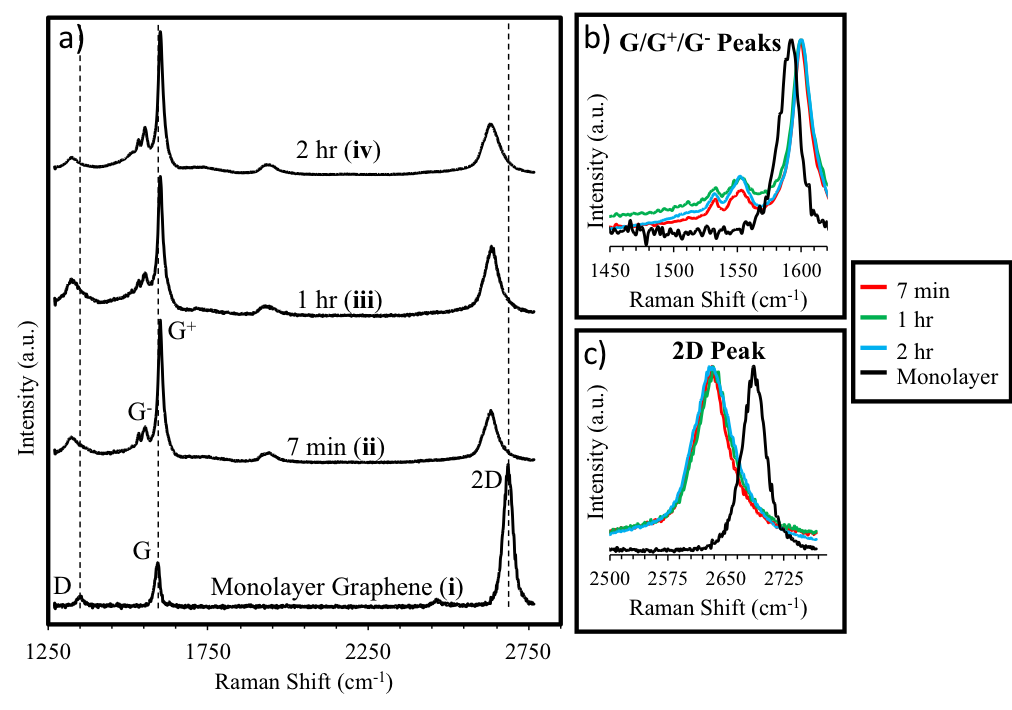
a) Averaged Raman spectra of 7 minutes (ii), 1 hour (iii), and 2 hour (iv) growths on 1 nm Ni/Au catalyst, and a monolayer graphene Raman spectrum (i) for comparison (grown on 1.5 μm Cu at 750 °C). Dashed lines indicate positions of D, G, and 2D peaks in monolayer graphene. b) Comparison of G peaks of all four growths, with all 1 nm grown spectra normalized to the G+ peak. c) Comparison of normalized 2D peaks of all four growths.
This report introduces a method for fabricating graphene at low temperatures via chemical vapor deposition enabled by ultra-thin (~1 nm) nickel-gold (Ni-Au) catalysts. The unique combination of high carbon (C) solubility Ni, low C solubility Au, and ultra-thin layer of catalyst, demonstrates the effectiveness to produce graphene at 450 °C with layer number independent of growth duration. In contrast to grain-boundary defined catalyst morphology found in thicker (>20 nm) metal catalysts, the ultra-thin catalyst morphology leads to the formation of nano-scale metal “islands” during the growth process, which results in curved graphene covering the catalyst.
To test the effect of pre-activation of the ultra-thin catalyst for the formation of graphene, a pre-anneal process of the catalyst followed by introduction of the carbon precursor was also investigated. The pre-anneal resulted in the formation of carbon nanotubes (CNTs) in lieu of graphene, displaying the impact of the catalytic surface treatment in relation to the produced materials. The results and discussion presented here detail a low-temperature nanoscale manufacturing process that allows for production of either graphene or CNTs on an ultra-thin catalyst.